Address
1782 W 2ND ST
POMONA, CA 91766
Monday to Friday: 7AM - 7PM
Weekend: 10AM - 5PM
Address
1782 W 2ND ST
POMONA, CA 91766
Monday to Friday: 7AM - 7PM
Weekend: 10AM - 5PM
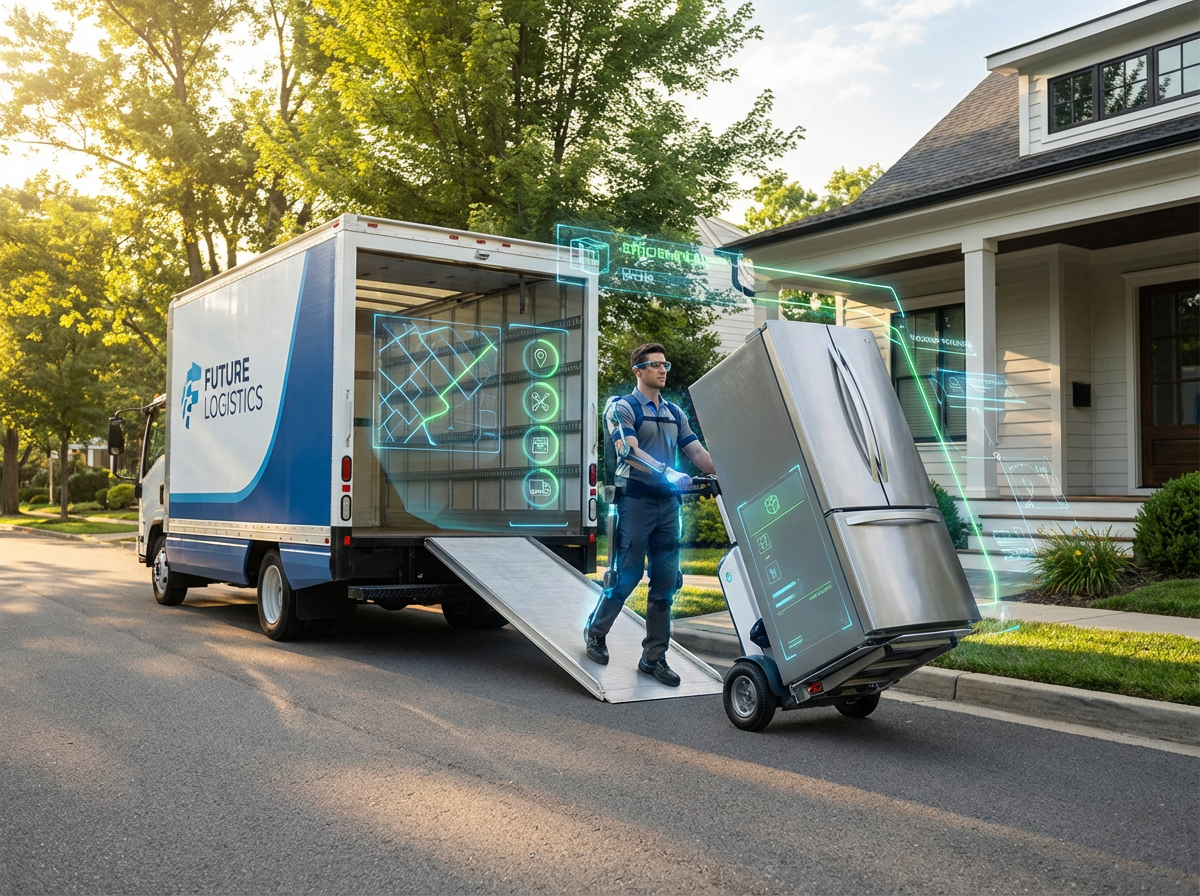
The last mile delivery sector is at a breaking point. As e-commerce continues to dominate, the demand for “Big & Bulky” item transport has shifted from a premium service to a baseline expectation.
In 2026, the industry is moving beyond the simple “Fast & Free” model. Today, the single biggest differentiator for logistics companies, HVAC installers, and moving firms is the ability to provide Safe, Precise, and Professional delivery for heavy items.
I analyzed the latest market data from McKinsey, DHL, and the Bureau of Labor Statistics to identify the core trends shaping the future of the final mile delivery. This report outlines the rise of premium white glove services, the critical role of safety-first logistics, and the undeniable ROI of investing in powered handling technology.
| Metric | 2026 Industry Benchmark |
| Consumer Priority | 60% of consumers now value reliable delivery commitments over pure speed [1]. |
| White Glove Demand | 45% increase in requests for “Room of Choice” placement for items over 150 lbs [2]. |
| Safety Impact | Powered stair climbers reduce ergonomic effort by 87% compared to manual hand trucks[3] . |
| Economic Cost | The average “Big & Bulky” delivery failure costs companies $150 – $250 in redelivery and damage claims [4]. |
| AI Adoption | 70% of top-tier 3PLs now use AI for predictive route and resource optimization [5]. |
The traditional parcel delivery model is no longer sufficient for the modern consumer. We are entering the era of “Big & Bulky” logistics, where the items being moved—refrigerators, gun safes, HVAC units, and commercial printers—require more than just a van and a driver.
According to recent industry reports, the market for heavy item delivery is projected to rebound significantly in 2026, driven by a surge in home improvement and commercial infrastructure projects [6] . However, this growth comes with a challenge: the “Last-Mile Gap.” This gap represents the difficulty of moving heavy objects from the delivery vehicle into the final location, often involving narrow hallways, slopes and multiple flights of stairs.
For companies like Soduro, this gap is where the battle for customer loyalty is won or lost. A delivery that ends at the curb is no longer considered a “completed” delivery in the eyes of the 2026 consumer.
White glove delivery has evolved from a luxury add-on to a competitive necessity. It is no longer just about “carrying the box inside.” In 2026, premium white glove service includes:
•Room-of-Choice Placement: Navigating heavy items through complex residential or commercial layouts.
•Professional Installation: Ensuring appliances or equipment are ready for immediate use.
•Debris Removal: Taking away all packaging materials, leaving the customer with a clean space.
•Haul-Away Services: Removing old units for recycling or disposal.
The data is clear: 60% of consumers now prioritize reliability and professional handling over delivery speed[1] . They would rather wait an extra day for a guaranteed, damage-free installation than receive a curb-side drop-off in 24 hours. This shift represents a massive opportunity for moving and logistics companies to command higher margins by offering specialized, high-touch services.
In the logistics industry, your workers are your most valuable—and most vulnerable—asset. Workplace injuries, particularly back strains and musculoskeletal disorders (MSDs), are the leading cause of employee turnover and rising workers’ comp premiums.
The “Safety-First” model isn’t just about compliance; it’s about Operational Resilience. When a lead mover is sidelined by a back injury, the cost to the company is staggering:
1.Direct Costs: Medical bills and legal fees (averaging over $40,000 for a serious back injury).
2.Indirect Costs: Lost productivity, overtime pay for remaining crew, and the cost of hiring/training a replacement (estimated at $5,000 – $7,000 per new hire).
3.Brand Damage: An injured crew is more likely to damage customer property, leading to negative reviews and lost future business.
By integrating powered stair climbers into daily operations, companies are effectively neutralizing the #1 risk factor in heavy item delivery: Manual Lifting on Stairs. These powered stair climbers take 100% of the lift off the human spine, reducing ergonomic effort by 87% [3].
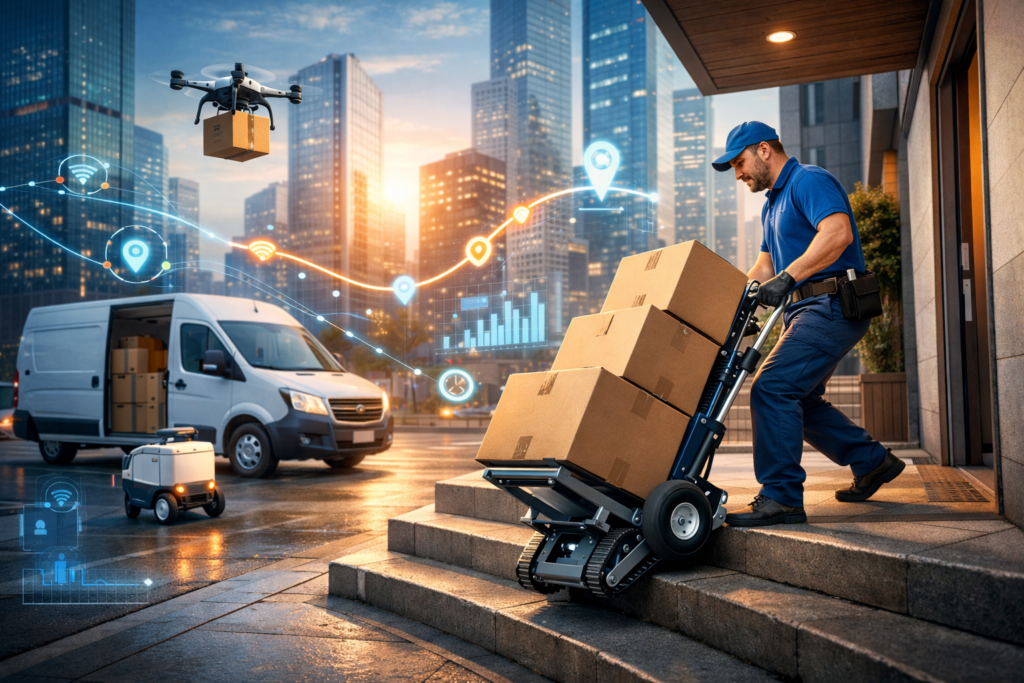
The future of the last mile is not just about better hardware; it’s about Intelligent Integration. In 2026, AI is no longer a “future trend”—it is everyday infrastructure.
Top-tier logistics firms are now using AI to:
•Predict Resource Needs: AI algorithms analyze order data to identify deliveries that require specialized equipment before the truck even leaves the warehouse.
•Optimize Route Density: Reducing fuel consumption and “windshield time” by grouping heavy item deliveries geographically.
•Enhance Communication: Providing customers with real-time, AI-calculated delivery windows that are accurate to within 15 minutes.
The real magic happens when this AI-driven planning meets specialized hardware. A fleet manager can now see, in real-time, which crews are equipped with powered stair climbers and assign them the most challenging “white glove” routes, ensuring maximum efficiency and zero injuries.
The most common objection to powered handling equipment is the upfront cost. However, when viewed through the lens of Risk Mitigation and Labor Efficiency, the ROI is undeniable.
Consider the “One-Man Crew” revolution. Traditionally, moving a 400 lb commercial printer up two flights of stairs required a 3-man crew. With a Soduro powered stair climber, that same task can be completed safely by a single operator.
•Traditional Crew: 3 men x $25/hr x 2 hours = $150 labor cost.
•Soduro-Equipped Crew: 1 man x $25/hr x 1 hour = $25 labor cost.
•Savings per Delivery: $125.
If your company performs just 30 such deliveries a month, you are saving $3,750 in labor costs alone. The equipment pays for itself in less than 45 days. This doesn’t even account for the thousands of dollars saved by preventing a single workers’ comp claim.
OSHA and other regulatory bodies are tightening their focus on ergonomic safety. Under the General Duty Clause, employers are increasingly being held accountable for failing to provide mechanical lifting aids for heavy loads.
In 2026, “Serious” OSHA violations can cost over $16,000 per instance. More importantly, many insurance providers are now offering premium discounts to logistics companies that can prove they use powered handling equipment to mitigate risk. Safety is no longer just a cost center—it is a financial asset.
The future of last mile delivery belongs to the professionals. As the “Big & Bulky” market grows, the companies that will thrive are those that invest in their people, their technology, and their equipment.
By transitioning to a Safety-First, Tech-Enabled model, you aren’t just moving boxes; you are building a resilient, high-margin business. You are keeping your best employees, protecting your profit margins, and providing a level of service that manual-only competitors simply cannot match.
The question for 2026 is not whether you can afford to invest in powered handling technology. The question is: Can you afford the cost of staying manual?
[2] Ryder. (2026, February 12). The Ultimate Guide to White Glove Delivery in 2026.
[3] PowerMate. (n.d.). Powered Hand Trucks for Moving Applications.
[4] Bringg. (2026, February 4). 2026 Last-Mile Reality: Quality Delivery Beats Fast and Free.
[5] TechTrans. (2025, December 29). 2026 Logistics Trends: AI-Powered Supply Chains.
[6] 3PLogistics. (2024, June 20). Big and Bulky Last-Mile Delivery in the United States.

