Address
1782 W 2ND ST
POMONA, CA 91766
Monday to Friday: 7AM - 7PM
Weekend: 10AM - 5PM
Address
1782 W 2ND ST
POMONA, CA 91766
Monday to Friday: 7AM - 7PM
Weekend: 10AM - 5PM
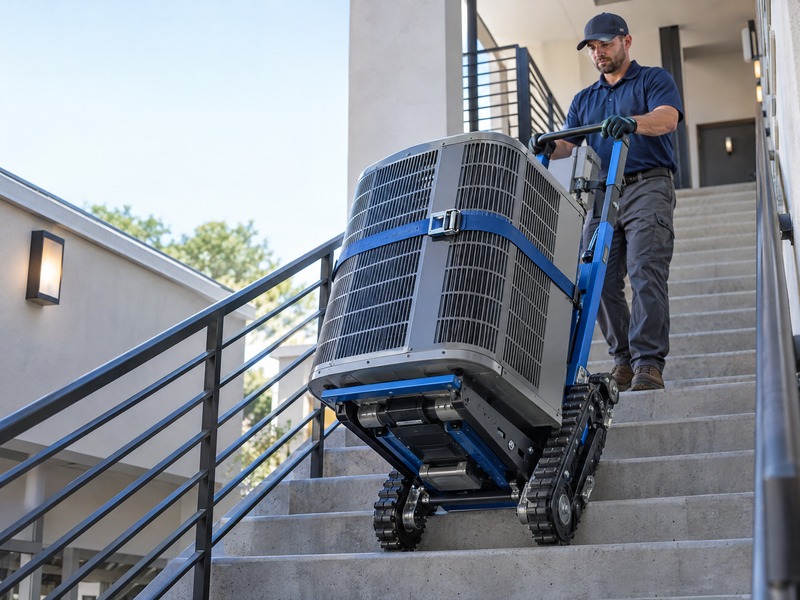
If your team regularly moves HVAC equipment, appliances, furniture, or commercial supplies up and down stairs, you already know the problem: a job that looks simple on paper can become slow, exhausting, dangerous and expensive the moment there is no usable elevator.
A powered stair climbing hand truck may solve that problem. But it also costs much more than a traditional dolly, takes up vehicle space, requires charging and maintenance, and may not fit every staircase. So are stair climbing hand trucks actually worth the investment?
The short answer is yes—when stairs are a recurring business problem and the equipment is correctly matched to your loads and routes.
In this guide, you will learn how to decide whether a powered stair climber makes financial sense for your business, when a conventional hand truck is the better choice, what limitations to check before buying, and how to calculate your potential payback.
A stair climbing hand truck is a material-handling device designed to move loads up or down stairs. Manual models may use rotating wheel clusters. Powered models add an electric motor and a climbing mechanism, such as lifting arms, powered wheels, or tracks.
Unlike a standard two-wheel hand truck, a powered stair climber helps control the load as it moves over each step. Depending on the model, the operator may control speed, braking, direction, or the climbing mechanism from the handle.
That does not mean every stair climber works on every staircase. Performance depends on several factors, including:
•Load weight and dimensions
•Load center of gravity
•Stair width and turning space
•Tread depth and riser height
•Straight vs. spiral stairs
•Landing size
•Indoor, outdoor, wet, carpeted, or uneven surfaces
•Whether the load can be securely strapped
The right question is not, “Can this machine climb stairs?” The better question is, “Can this model safely and efficiently move our regular loads through our actual routes?”
A powered stair climbing hand truck is usually worth considering if your business answers “yes” to several of these questions:
•Do you move heavy or awkward loads up or down stairs several times per week?
•Do jobs often require two workers because of the stairs?
•Do you lose time unloading, repositioning, or carrying loads by hand?
•Do your routes include walk-up apartments, basements, offices, or buildings without freight elevators?
•Do delays, overtime, product damage, or worker strain create a measurable cost?
•Could faster stair deliveries allow your team to complete more jobs?
It may not be worth it if most of your work happens on flat warehouse floors, your loads are light, or you only encounter stairs a few times each year.
The purchase decision comes down to five variables:
Frequency × load difficulty × labor cost × route fit × equipment price
If the same difficult stair jobs happen repeatedly, the equipment has a better chance of paying for itself. If the machine would sit unused, a traditional hand truck, ramp, liftgate, or occasional rental may be more economical.
Moving a heavy load up stairs with a conventional hand truck requires the operator to control the load’s angle, balance, and momentum one step at a time. That can create high physical demands, especially when the load is bulky or the stairs are uneven.
OSHA identifies awkward postures and forceful exertion as material-handling hazards. It recommends using stair-climbing hand trucks to transport materials up and down stairs, and powered hand trucks with stair-climbing or self-leveling capabilities when stairs cannot be avoided.
A powered stair climber does not remove every risk. It can, however, reduce the amount of lifting, pulling, and abrupt repositioning required from the operator when used within its rated conditions.
For many businesses, the most important benefit is not simply that the machine feels easier to use. It is that a suitable load may be handled by one trained operator instead of requiring a second person for the stair portion of the job. There is potential work injuires if hire workers.
That can matter for:
•HVAC contractors moving condensers, furnaces, boilers, or water heaters
•Property maintenance teams delivering appliances inside apartment buildings
•Moving companies handling furniture in walk-up homes
•Logistics providers completing residential or commercial deliveries
•Contractors transporting equipment into basements or upper floors
This should be treated as a potential operating benefit, not a guarantee. The correct number of workers depends on the load, route, visibility, local procedures, potienal risk and manufacturer instructions.
A conventional dolly may work well on a loading dock and then become difficult to control as soon as the route reaches stairs. The crew may need to stop, change grip positions, unload part of the shipment, or call for additional help.
A powered stair climber can make the stair portion of a suitable job more repeatable. That may help a company plan routes, quote labor, and schedule technicians with greater confidence.
A business that avoids walk-up deliveries or charges a large labor premium for them may be able to accept more of those jobs with the right equipment.
This is especially relevant in cities and older buildings where elevators are small, unreliable, or unavailable. It is also relevant for HVAC and mechanical contractors working in homes with basement stairs, second-floor equipment rooms, or narrow access routes.
The U.S. Bureau of Labor Statistics reported 835,040 injury and illness cases involving days away from work, restricted work, or job transfer among transportation and material moving occupations during 2021–2022. Of those cases, 329,150 were attributed to overexertion and bodily reaction.
That statistic does not prove that a particular stair climber will reduce injuries by a specific percentage. It does show why businesses should take repetitive, forceful material handling seriously when evaluating equipment.
Powered equipment is not automatically the best answer. A conventional hand truck may be the better choice in these situations.
If your team primarily moves pallets across smooth warehouse floors or loads trucks at a dock, a standard hand truck or pallet jack may provide all the value you need.
For light boxes or infrequent residential moves, the purchase price of a powered stair climber may take too long to recover. In that case, a manual stair-climbing hand truck, ramp, rental, or two-person method may be more practical.
A machine can have enough load capacity and still be the wrong tool for a particular building. Tight landings, winding staircases, narrow doorways, or limited turning space may prevent safe operation.
An HVAC discussion illustrates this concern: some installations involve narrow, winding stairs where an electric hand truck may be too bulky. That is not a universal limitation, but it is a reason to measure your routes before ordering.
A ramp, liftgate, freight elevator, forklift, pallet jack, or material lift may be more suitable depending on the job. A stair climber should be evaluated as part of your complete material-handling process—not as a replacement for every other tool.
Do not rely on a generic claim that a stair climber will “save money.” Calculate the potential benefit using your own jobs.
Count the jobs where your team moves a meaningful load up or down stairs. Use an average month rather than your busiest month.
Step 2: Estimate the labor time saved per job
Compare the current process with the expected process. Include time spent:
•Calling in a second worker
•Waiting for help
•Unloading and reloading the item
•Making multiple trips
•Repositioning the load
•Recovering between difficult lifts
Be conservative. If you think the equipment will save 30 minutes, use 20 minutes in your first estimate.
Use the real hourly cost of the people involved, including wages, payroll costs, insurance, and other employer expenses where appropriate.
Depending on your business, the equipment may also affect:
•Overtime
•Rental costs
•Number of jobs completed per day
•Missed delivery windows
•Product damage
•Worker compensation exposure
•Customer rescheduling and complaints
Only include benefits you can explain and measure. Do not count every possible advantage as guaranteed savings.
Monthly benefit = labor savings + additional contribution from extra jobs + avoided costs
Payback period = equipment price ÷ monthly benefit
Suppose a moving or HVAC company buys a powered stair climbing hand truck for $2,000 and handles 40 stair jobs per month.
Assume:
•Average time saved: 20 minutes per job
•Loaded labor cost: $30 per hour
•Monthly stair jobs: 40
The estimated labor benefit would be:
40 jobs × 1/3 hour × $30 = $400 per month
The simple labor-only payback would be:
$2,000 ÷ $400 = 5 months
This is an illustration, not a promised result. Actual payback may be faster if the machine helps your team complete more profitable jobs. It may be slower if the route is difficult, the machine is rarely used, or charging and maintenance interrupt operations.
A traditional hand truck is often the right tool for flat ground and lighter loads. A powered stair climber becomes more attractive when stairs are a frequent part of the job and the load creates a real labor or safety challenge.
•Most work happens on flat surfaces
•Loads are relatively light
•Stair jobs are rare
•Purchase price is the main priority
•The team already has a safe and efficient process
•Stair deliveries are recurring
•Loads are heavy, bulky, or difficult to control
•A second worker is frequently needed
•The route has no practical elevator or ramp
•Labor time and delivery delays have a measurable cost
•The equipment fits the actual stairway and load
PowerMate positions powered stair climbers as tools for stairs, curbs, thresholds, vehicles, and loading areas. Magliner emphasizes comparing load capacity, stairway type, handle design, nose plate size, and wheel type. These are useful decision factors because “powered” alone does not tell you whether a model is right for your work.
Manual tri-wheel designs can be a lower-cost option for lighter loads and occasional stair use. They still require the operator to provide significant control and effort, so they should not be treated as equivalent to a powered model.
These models use a powered mechanism to move the load over the steps. They can be a good fit for commercial users who need stair assistance while maintaining a relatively compact and maneuverable design.
Tracked stair climbers use a continuous track system to move over the stairs. They may be attractive for certain heavy-load applications, but they can also be larger, heavier, and more expensive. Confirm that the track design suits your stair surfaces and turning areas.
Heavy-duty models are designed for demanding loads such as safes, commercial HVAC equipment, industrial supplies, or other bulky items. A higher capacity does not automatically make a machine safer. Load dimensions, balance, restraints, and route conditions still matter.
Handtrucks2GO describes three broad powered categories—lifting-cam, tracked, and screw-driven systems—each with different operating characteristics. That is why buyers should compare the mechanism and use case, not only the maximum capacity.
Use this checklist before choosing a model:
1.What is the heaviest load we move regularly?
2.What are the load’s dimensions and center of gravity?
3.What is the narrowest stairway and doorway on our typical route?
4.Are the stairs straight, turning, outdoor, carpeted, wet, or uneven?
5.How much landing space is available at the top and bottom?
6.Can the load be secured with the supplied straps or an approved restraint system?
7.What is the practical operating range per charge for our workload?
8.How much does the machine weigh, and can the crew load it into a van or truck?
9.What warranty, service, training, and replacement parts are available in the United States?
10.What is the expected payback based on our actual monthly stair jobs?
Magliner’s own buying guidance centers on four important factors: load capacity, stairway type, handle ergonomics, and wheel type. Add machine weight and service support because both affect everyday usability.
A powered stair climbing hand truck can reduce manual effort, but it does not make an unsafe route safe automatically.
Before each job:
•Check the machine, wheels, brakes, frame, straps, and battery.
•Confirm that the load is within the rated capacity.
•Secure the load before entering the stairs.
•Clear the route and check each landing.
•Make sure the operator can maintain visibility and firm footing.
•Follow the operating instructions for the specific model.
•Use a second person or spotter when the load, route, or visibility requires it.
•Stop if the stairs, surface, load, or machine is outside the rated conditions.
OSHA recommends suitable transport devices, correct operating posture, visible loads, and powered stair-climbing equipment when stairs cannot be avoided. It also notes that rough terrain and stairs can create abrupt impacts that strain the shoulders and back.
A stair climber is a mechanical aid. It is not permission to exceed capacity, skip training, or move an unstable load alone.
Answer each question with “yes” or “no.”
•We move heavy loads over stairs at least several times per month.
•Stair jobs regularly require a second worker.
•We lose measurable time to difficult stair routes.
•We operate in buildings without convenient freight elevators.
•We regularly move loads heavier than a practical manual process.
•We have measured our narrowest stairs, landings, and doorways.
•We can secure our typical loads properly.
•We can charge, store, inspect, and maintain the equipment.
•We have calculated a realistic payback period.
•We would use the machine often enough to justify its purchase price.
0–2 “yes” answers: A traditional hand truck, ramp, rental, or existing process may be more economical.
3–5 “yes” answers: Compare the cost of a powered model with your current labor and delay costs.
6–10 “yes” answers: A powered stair climber may be a strong candidate. Request a route-fit review before choosing a model.
This is a practical screening tool, not a scientific score. The final decision should still be based on the actual load, staircase, operator, and business case.
Stair climbing hand trucks are worth it when stairs are a recurring operating problem and the machine is matched to the load and route.
They can help businesses reduce manual handling, improve delivery consistency, make better use of labor, and take on jobs that are difficult with a conventional dolly. The strongest business case usually comes from frequent stair work involving heavy or awkward loads.

