Address
1782 W 2ND ST
POMONA, CA 91766
Monday to Friday: 7AM - 7PM
Weekend: 10AM - 5PM
Address
1782 W 2ND ST
POMONA, CA 91766
Monday to Friday: 7AM - 7PM
Weekend: 10AM - 5PM
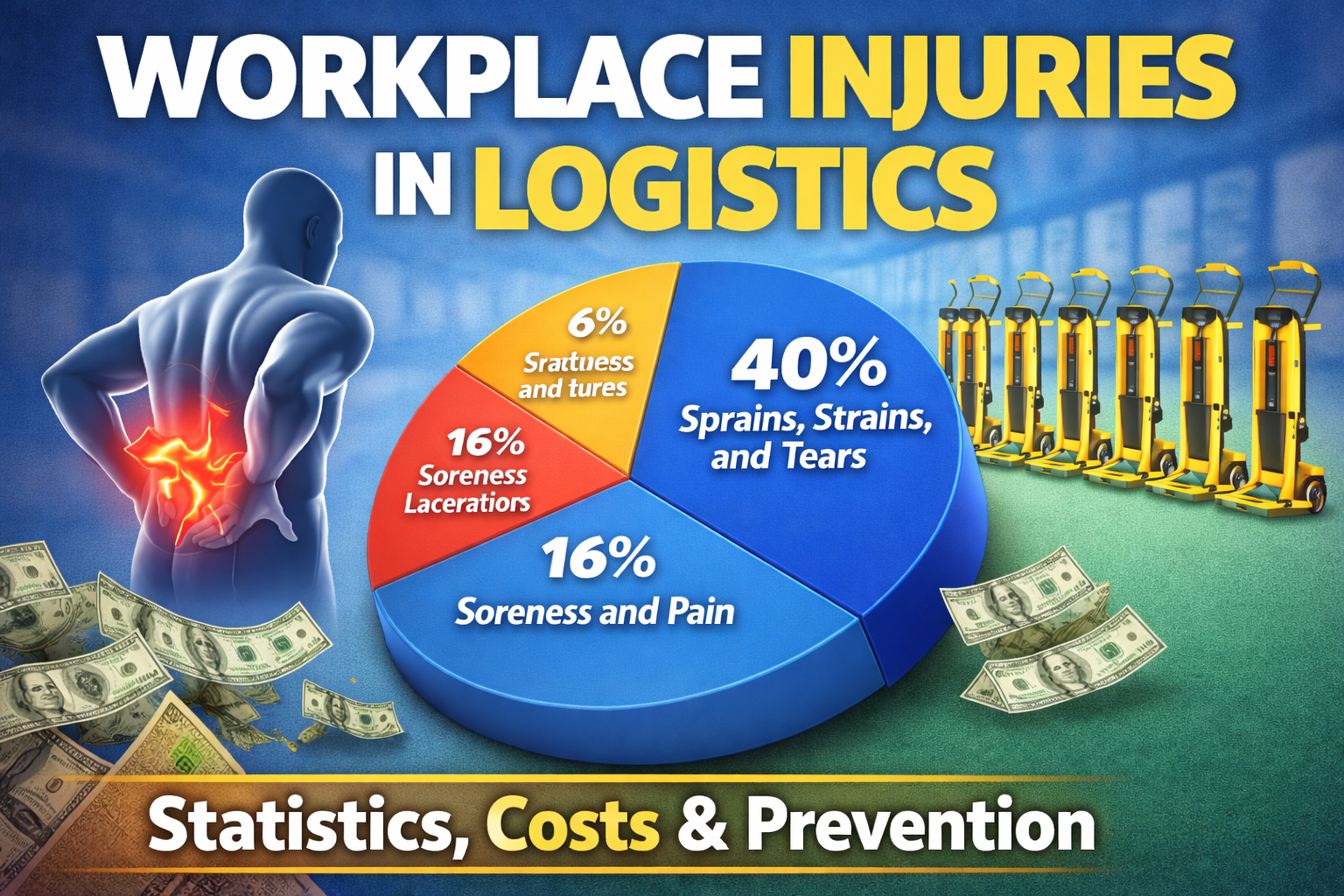
The logistics and moving industry is physically punishing. There’s no other way to put it.
Every day, your crew faces the risk of a career-ending injury. And here’s the truth: workplace injuries are the single biggest threat to a moving company’s profit margin in 2026.
I analyzed the latest industry data from OSHA, the Bureau of Labor Statistics (BLS), and the National Safety Council (NSC) to find out exactly how much these injuries are costing companies this year.
In this report, you’ll see the true cost of manual lifting, the impact on employee turnover, and the exact ROI of investing in modern safety equipment.
2026 Key Findings
•4.4 per 100: The injury rate in transportation and warehousing—nearly double the private sector average[1] .
•$41,757: The average workers’ comp claim for a single lower back injury in 2026 [2].
•87% Reduction: The decrease in ergonomic effort when using powered stair climbers vs. manual hand trucks [3].
•$181.4 Billion: The total cost of work injuries to the U.S. economy this year[4] .
•232,000+: Total reported injuries in the transportation and warehousing sector annually[5] .
Logistics is a high-stakes game. But the stakes are highest for the people on the ground.
According to the latest BLS data, the transportation and warehousing sector remains one of the most hazardous industries in America. With over 232,000 reported injuries annually, the sector posts an injury rate of 4.4 to 4.5 per 100 full-time workers [5][6].
To put that in perspective: that’s more than double the national private sector average of 2.4[7] .
But what kind of injuries are we talking about?
It’s not just “accidents.” It’s the repetitive, grueling nature of the work. Sprains, strains, and tears make up the vast majority of nonfatal injuries.
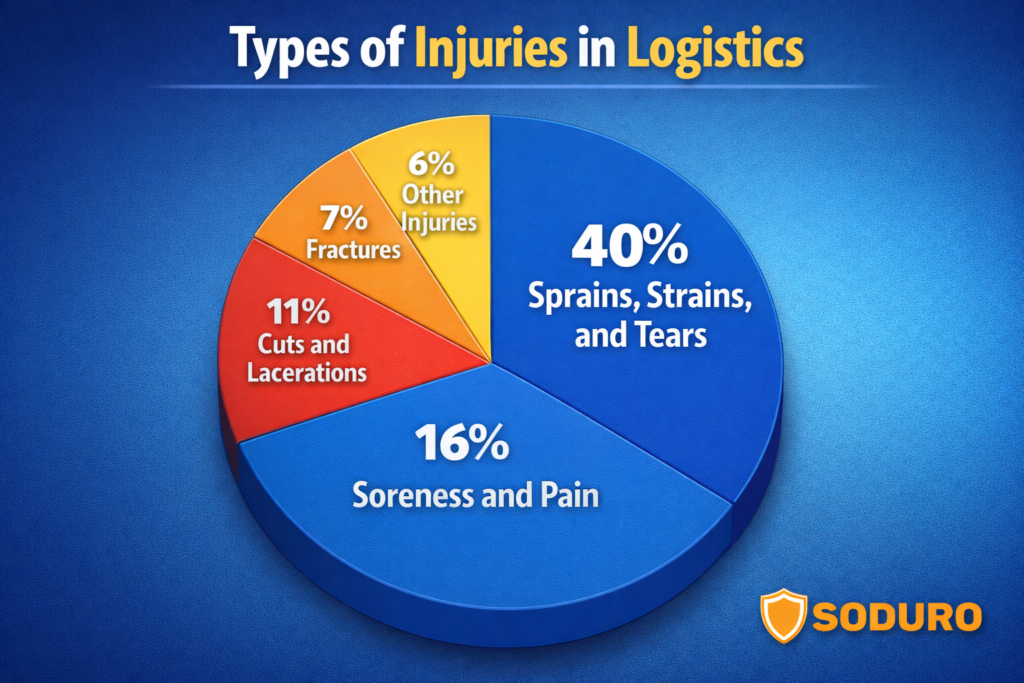
Note to Readers: Feel free to use this chart on your site. We just ask that you link back to this page as the original source.
Here’s the deal: Most owners look at a workers’ comp premium and think that’s the “cost” of safety.
They’re wrong.
The direct costs—medical bills and legal fees—are just the tip of the iceberg. According to the National Safety Council, the average cost per medically consulted injury is now $43,000 [4].
But for back injuries specifically? The numbers are staggering.
A single lower back injury claim now averages $41,757 [2] in direct costs .
But wait, there’s more.
You also have to account for Indirect Costs:
•Lost Productivity: When your best mover is out, the whole team slows down.
•Damaged Goods: Tired or injured workers are more likely to drop that $5,000 refrigerator.
•Overtime Pay: You have to pay other workers time-and-a-half to cover the gap.
•Administrative Time: Hours spent filing paperwork and managing the claim.
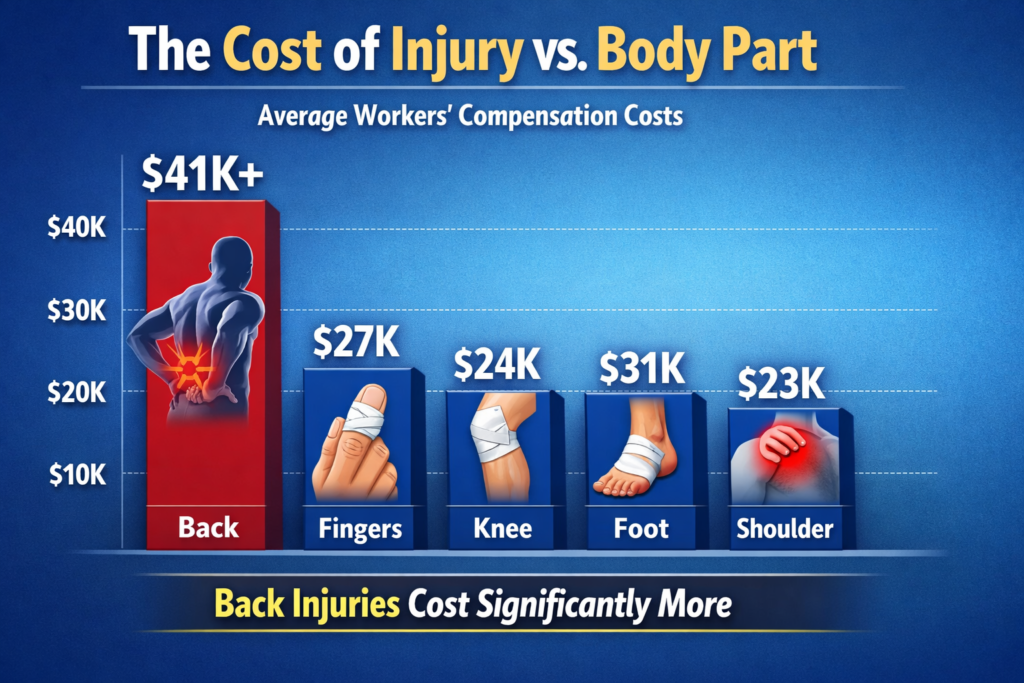
But the medical bills are just the tip of the iceberg. Here’s why:
When a top mover gets hurt, they don’t just “take a day off.”
In the logistics sector, injuries involving days away from work are at an all-time high. The average back injury results in 12 to 15 lost workdays.
That’s two full weeks of a missing lead man.
This leads to a vicious cycle. The remaining crew has to work harder, leading to more fatigue and more injuries.
The result? Employee Turnover.
In 2026, the cost of hiring and training a new specialized mover is estimated at $5,000 to $7,000. If you’re losing 20% of your staff to injury-related burnout, you’re flushing six figures down the drain every year.
But it’s not just about the money. It’s about Institutional Knowledge. When your lead mover—the one who knows exactly how to navigate a 400lb safe through a narrow Victorian hallway—gets injured, that knowledge leaves the building. You can’t replace 10 years of experience with a $15-an-hour temp.
This leads to a decline in service quality, more customer complaints, and a tarnished brand reputation. In the age of Google Reviews, one “injured mover dropped my piano” comment can cost you dozens of future leads.
Let’s talk about something most logistics owners ignore: The Fear Factor.
When your crew is asked to move a heavy HVAC unit up three flights of stairs with nothing but a manual dolly and “grit,” they aren’t just working hard. They are working in fear.
They know that one slip, one misstep, or one muscle twitch could mean they can’t pick up their kids for a month. This constant low-level stress leads to Burnout.
According to recent HR surveys in the logistics sector, “Safety Concerns” are now the #2 reason employees leave their jobs, second only to “Pay.” By providing powered equipment, you aren’t just protecting their backs; you’re protecting their peace of mind.
A crew that feels safe is a crew that stays. They work faster, they complain less, and they take pride in using professional-grade tools. It changes the culture from “survival of the fittest” to “professionalism through technology.”
This is the core of the issue.
Logistics owners often tell me: “Soduro, powered stair climbers are expensive.”
My response? “Compared to what?”
Let’s look at the data. Frame the narrative differently. Investing in equipment isn’t an “expense”—it’s a high-yield insurance policy.
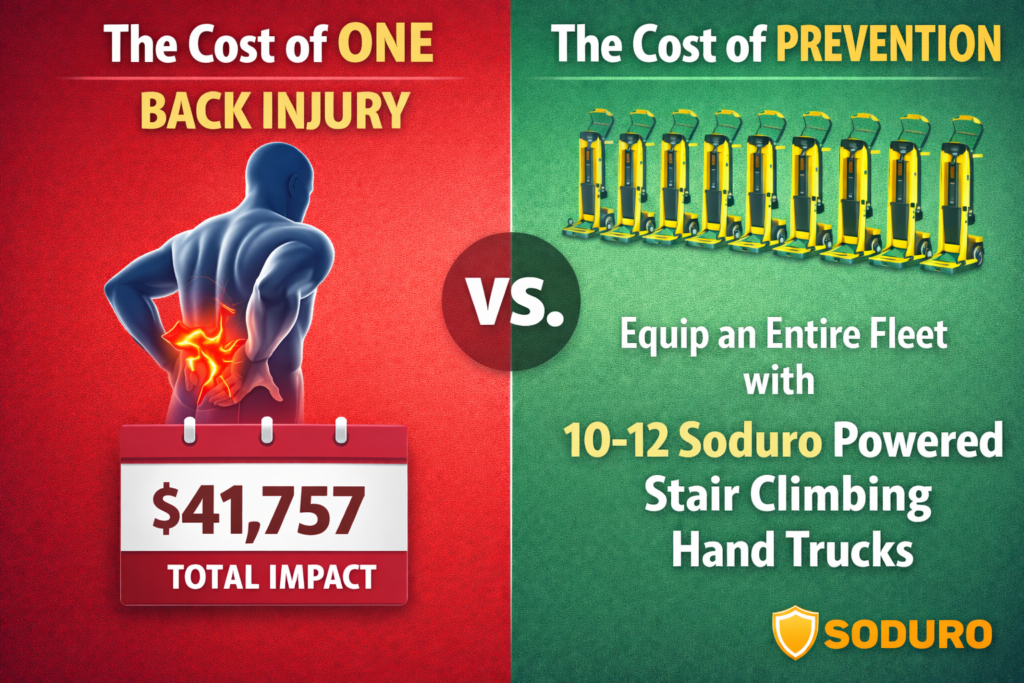
By using powered equipment, you are directly neutralizing the #1 cause of workplace injuries: Manual Lifting on Stairs.
Powered stair climbers reduce the operator’s ergonomic effort by 87% [3] . You’re taking the weight off the human spine and putting it on a high-torque motor.
It’s not just about safety. It’s about Efficiency.
One man with a Soduro can often do the work of three men with a traditional dolly. That’s two extra salaries you aren’t paying for every single move.
Think about your current payroll. If you can reduce a 3-man crew to a 2-man crew (or even a 1-man crew for smaller appliances), the equipment pays for itself in less than 30 days.
We recently spoke with an HVAC contractor in Pennsylvania who was struggling with high turnover. His team was moving 300lb boilers up basement stairs daily.
After equipping his lead tech with a Soduro ZW7170, he was able to:
1.Reduce Crew Size: From 2 men to 1 man for 80% of his installs.
2.Increase Volume: They went from 2 installs a day to 3.
3.Zero Injuries: In the 12 months since the switch, he hasn’t had a single back-related workers’ comp claim.
The math is simple: $4,000 for a machine vs. $40,000 for an injury. It’s the easiest financial decision you’ll make all year.
What does the government have to say about this?
OSHA is very clear. Under the General Duty Clause, employers are required to provide a workplace free from recognized hazards [8].
Specifically, OSHA recommends the use of “mechanical lifting aids” to prevent musculoskeletal disorders (MSDs)[9] . They explicitly state that manual lifting of heavy loads—especially on stairs—should be avoided whenever a mechanical solution exists.
Ignoring these guidelines doesn’t just lead to injuries; it leads to massive OSHA fines. In 2026, a “Serious” violation can cost your company over $16,000 per instance.
Investing in safety equipment isn’t just about “being nice” to your employees.
It’s about:
1.Keeping your best people (who don’t want to destroy their backs).
2.Lowering your insurance premiums (by reducing your E-Mod rating).
3.Increasing your speed (by moving faster with less effort).
In 2026, the companies that win are the ones that leverage technology to protect their most valuable asset: their people.
Now I’d love to hear from you:
What is the biggest challenge your team faces when moving heavy items on stairs? Is it the weight, the narrow turns, or the sheer volume of moves?
Let me know by leaving a comment below right now.
Want to protect your crew from workplace injuries?
Browse Soduro’s line of Powered Stair Climbing Hand Trucks here.
[2] National Safety Council. (n.d.). Workers’ Compensation Costs by Part of Body. Retrieved from
[3] PowerMate. (n.d.). Powered Hand Trucks for Moving Applications. Retrieved from
[4] National Safety Council. (n.d.). Work Injury Costs. Retrieved from
[6] Voxel AI. (2026). 50 Logistics Safety Statistics. Retrieved from
[7] OSHA. (2026). 2026 Low-Hazard Industries Table. Retrieved from
[8] OSHA. (n.d.). OSH Act of 1970 – Section 5: Duties. Retrieved from
[9] OSHA. (n.d.). Ergonomics: Solutions to Control Hazards. Retrieved from

