Address
1782 W 2ND ST
POMONA, CA 91766
Monday to Friday: 7AM - 7PM
Weekend: 10AM - 5PM
Address
1782 W 2ND ST
POMONA, CA 91766
Monday to Friday: 7AM - 7PM
Weekend: 10AM - 5PM
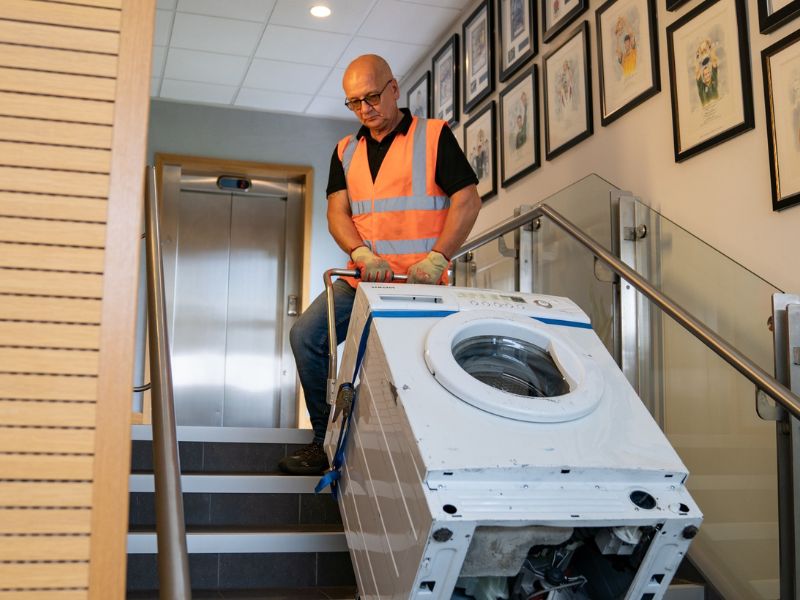
If you run a home appliance moving company, manage properties, or handle heavy HVAC installations, you already know the truth.
Moving heavy appliances is tough.
But trying to move washer and dryer upstairs?
That’s a completely different beast.
One slip can lead to a damaged $2,000 appliance. A scratched hardwood staircase. Or worse: a serious back injury for you or your crew.
Look:
Whether you are moving a stacked unit into a tight second-floor condo, or outfitting a school or hospital with commercial laundry gear, you need a foolproof system.
And today, I’m going to share that exact system with you.
In this guide, I’ll show you step-by-step how to move washer and dryer upstairs safely, quickly, and with zero damage.
Plus, I’ll reveal the exact piece of equipment the top-tier pros are using to turn a grueling two-man job into a quick one-man breeze.
Let’s dive right in.
Here’s the deal.
Most moving disasters don’t happen on the stairs. They happen because of poor planning before the appliance even leaves the ground floor.
If you want to move washer and dryer upstairs without breaking a sweat, you need to prep the environment.
Here is exactly how to do it.
Step 1: Measure Everything (The “Clearance Rule”)
Before you touch the washer or dryer, grab a tape measure.
You need to measure three things:
Pro Tip: Always account for the moving equipment. If your hand truck adds 6 inches of width, make sure you still have clearance. If you don’t have at least an inch of breathing room on either side, you need to take the doors off their hinges.
Step 2: Clear the Path
This sounds obvious. But you’d be surprised how many moving companies ignore it.
Remove any tripping hazards.
That means:
Step 3: Gather the Right Gear
If you are using a standard, non-powered hand truck to move appliances upstairs… you are working way too hard.
Old-school manual dollies require immense upper body strength. They bounce on the stairs. They damage the nosing of the steps.
If you are a professional HVAC installer, property manager, or appliance mover, you need a powered stair climber.
Specifically, the XSTO Stair Climber.
At Soduro.com, we supply these state-of-the-art machines to pros who need to move heavy heaters, safes, and appliances daily. Unlike heavy, clunky alternatives, XSTO stair climbers do 100% of the heavy lifting.
You’ll also need:
You can’t just unplug a washer and throw it on a dolly.
Washers hold hidden water. Dryers have fragile doors. You need to lock them down.
Step 1: Disconnect and Drain
First, unplug the power cords for both units. Tape the cords securely to the back of the machines so they don’t dangle and become tripping hazards.
Next, turn off the water valves for the washer. Disconnect the hot and cold water hoses.
Warning: Have a bucket ready! Hoses always hold leftover water. Drain them completely into the bucket.
Step 2: Lock the Washer Drum
This is a step that amateur movers almost always miss.
Inside a washing machine, the drum is suspended by springs. If you tilt a washer back and bounce it up a flight of stairs, that drum will swing violently. This can permanently destroy the suspension.
If you have the original shipping bolts that came with the washer, install them into the back of the machine. This locks the drum in place.
If you don’t have them, you must keep the washer as upright as possible during the move. (Which is another reason why powered stair climbers are essential—they allow for better angle control).
Step 3: Tape the Doors and Wrap
Dryer and washer doors swing open easily.
Take your packing tape and tape the doors shut. Tape down the lint trap, too.
Finally, wrap both units snugly in thick moving blankets. Secure the blankets with stretch wrap or tape. This protects the finish of the appliance and protects the client’s walls from scratches.
Now it’s time for the heavy lifting.
If you want to safely move washer and dryer upstairs, the execution here is everything.
Let’s break it down into simple, actionable steps.
Step 1: Load the Appliance onto the Climber
Slide the toe plate of your powered stair climber securely under the front of the washing machine.
Why the front? Because the back of a washer contains hoses, protruding knobs, and cords that can be easily crushed. The front and sides are much stronger.
Step 2: Strap It Down Tight
Never rely on gravity.
Take a heavy-duty strap and wrap it entirely around the washer and the frame of the stair climber.
Tighten it until the appliance and the stair climber feel like one single, solid unit. If the washer wiggles even a fraction of an inch, tighten it more.
Step 3: The Ascent
Here is where the men are separated from the boys.
If you are using a manual hand truck:
You need two strong people. One person pulls from the top, stepping backward up the stairs (incredibly dangerous). The second person pushes from the bottom, lifting the weight over every single step.
It’s exhausting. It’s a massive liability.
But if you are using an XSTO Powered Stair Climber from Soduro:
This becomes a one-man job.
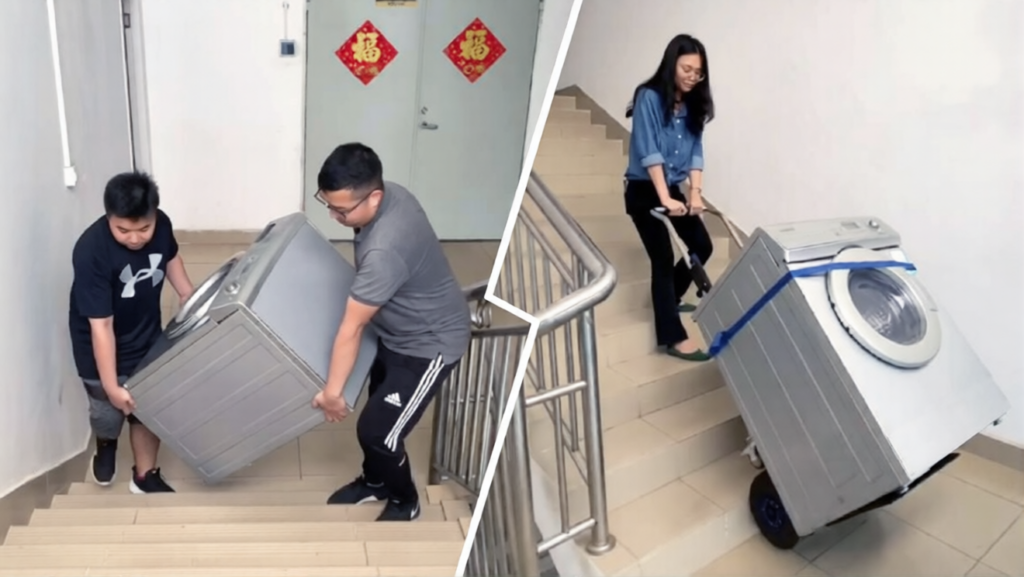
Here is exactly how to move washer and dryer upstairs using the XSTO:
The machine does the lifting. You don’t strain your back. The stairs don’t get gouged.
It’s literally that easy.
You repeat this process step-by-step until you reach the landing.
Step 4: Navigating Tight Landings
Most staircases have a landing that requires a 90-degree or 180-degree turn.
With bulky traditional dollies, this is a nightmare. But because XSTO stair climbers are designed with an incredibly tight turning radius, you can pivot the machine easily on a standard landing.
Simply roll it into the corner, pivot the wheels, and align it with the next set of stairs.
You made it to the top floor.
But the job isn’t done yet.
Step 1: Wheel to the Laundry Room
Keep the appliance strapped to the stair climber until you are right in front of its final resting spot. The less you have to “walk” or drag the appliance across the floor, the better.
Step 2: Unstrap and Unwrap
Carefully loosen the straps. Slide the toe plate out from underneath the appliance.
Remove the moving blankets and the tape holding the doors shut.
(Pro Tip: If you installed shipping bolts to protect the washer drum, remove them NOW. If you run a washer with the shipping bolts still in, it will literally tear itself apart).
Step 3: Connect and Level
Re-attach your hot and cold water hoses. Plug the machines back in. Reattach the dryer vent securely.
Finally, grab a bubble level. Place it on top of the washer. Adjust the little feet at the bottom of the machine until it is perfectly level. An unlevel washer will vibrate loudly and damage the client’s floors.
Let me ask you a question.
If you run an HVAC installation business, a property management group, or an appliance delivery service… what is your biggest overhead cost?
Labor.
And what is your biggest liability?
Employee injuries and property damage.
When you use manual hand trucks to move washer and dryer upstairs (or heavy AC units, photocopiers, and safes), you are burning through labor and risking injury every single day.
You need two, sometimes three guys just to move one commercial washing machine up a flight of stairs in a school or hospital.
That’s a massive waste of resources.
Enter the modern powered stair climber.
At Soduro.com, we specialize in providing businesses with the ultimate solution: the XSTO Stair Climber.
Here is why top professionals are switching to XSTO:
While competitors offer heavy, outdated equipment, Soduro provides the modern, agile, and incredibly powerful XSTO lineup designed specifically for today’s fast-paced professionals.
If you want to know how to move washer and dryer upstairs the smart way, it comes down to having the right equipment.
Preparation is key. Strapping is vital.
But replacing human muscle with motorized precision is the ultimate game-changer.
Are you tired of risking your back on steep staircases?
Are you ready to make your deliveries faster, safer, and more profitable?
Head over to Soduro.com right now.
Browse our exclusive selection of XSTO powered stair climbers. Whether you are moving household washers and dryers, or massive commercial HVAC units, we have the exact model you need to conquer any staircase.
Now I’d love to hear from you:
What is the heaviest appliance you’ve ever had to move upstairs?
Did you use a manual dolly, or did you have a motorized secret weapon?
Let me know by leaving a comment below right now.

