Address
1782 W 2ND ST
POMONA, CA 91766
Monday to Friday: 7AM - 7PM
Weekend: 10AM - 5PM
Address
1782 W 2ND ST
POMONA, CA 91766
Monday to Friday: 7AM - 7PM
Weekend: 10AM - 5PM
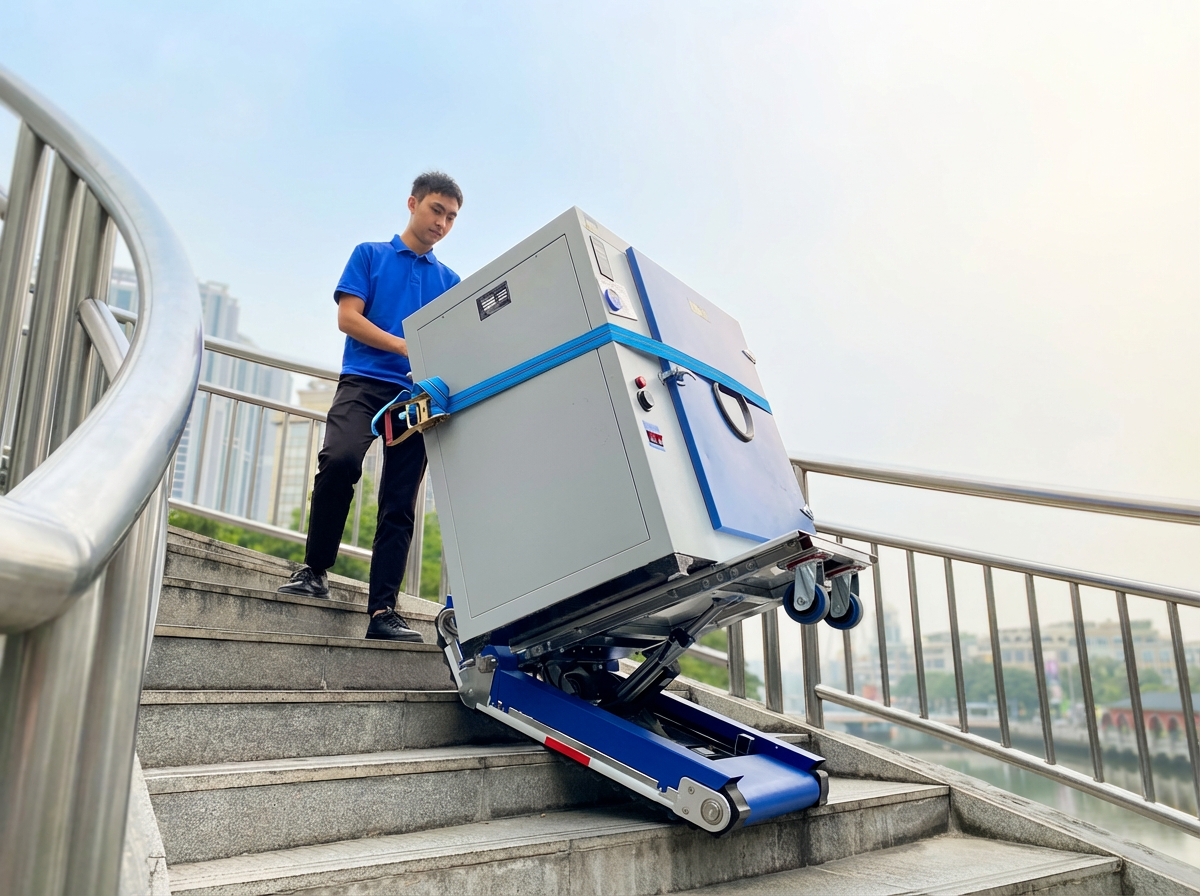
Moving a 500 lb appliance upstairs isn’t just a strength problem.
It’s a systems problem — and most injuries, dropped loads, and property damage happen because someone skipped a step in the system.
This guide is the professional standard for HVAC installers, property managers, logistics teams, and moving companies who regularly move heavy equipment in real-world conditions: tight stairwells, narrow landings, and loads that weigh as much as a grand piano.
Bookmark it. Share it with your crew. Train against it.ndard that logistics companies, HVAC installers, and property managers can rely on to reduce risk to near zero.
Most moving guides talk about refrigerators and washing machines.
This one starts where those guides end.
At 500 lbs and above, you’re not just dealing with weight. You’re dealing with:
The consequences of getting this wrong aren’t just property damage. Back and musculoskeletal injuries are the #1 cause of workplace injury among movers and installers in the US, accounting for billions in workers’ compensation claims annually.
The professionals who do this safely day after day don’t rely on brute strength. They rely on process.
Never show up to a job and assess on the fly. A proper site survey takes 20 minutes and prevents 80% of problems.
Measure everything:
Document the route:
Check structural capacity:
Not all 500 lb loads are equal. Classify before you plan equipment.
| Load Type | Key Risk Factor | Additional Precaution |
|---|---|---|
| HVAC unit / rooftop condenser | Irregular shape, exposed refrigerant lines | Protect lines; check refrigerant pressure post-move |
| Commercial safe | Extremely dense, low center of gravity | Anti-tip strapping critical; floor protection mandatory |
| Industrial copier / MFP | Top-heavy, fragile internal components | Manufacturer shipping locks required |
| Commercial washer/dryer | Drum can shift; water residue adds weight | Reinstall drum shipping bolts |
| Commercial refrigerator | Top-heavy when upright | Never tilt more than 45° |
This is non-negotiable.
Every piece of equipment involved in the move must have a verified load rating that exceeds your load weight by at least 25%.
Why the 25% margin? Dynamic loads — the actual force experienced during acceleration, deceleration, and stair climbing — consistently exceed static weight. A 500 lb load hitting a stair tread transition can spike to 600–700 lbs of force in real conditions.
Never rely on a product description alone. Check the manufacturer’s official load rating documentation.
A standard appliance hand truck maxes out at 600–800 lbs static on flat ground.
On stairs, that number means nothing.
On stairs, the operator experiences what’s called the “tipping moment” — the rotational force trying to pitch the load off the dolly. At 500 lbs, controlling that tipping moment manually on a staircase requires two strong operators and near-perfect technique. Every step.
One misstep — a wet tread, a distraction, a miscommunication — and the load is gone.
A powered stair climbing hand truck eliminates the tipping moment problem by using motorized crawler tracks that engage each stair tread mechanically. The load is driven up the stairs by the machine — not carried by the operator.
The operator’s job shifts from lifter to guide and spotter. That’s a fundamentally safer role.
Key features to verify when selecting a powered stair climber for 500 lb+ loads:
At Soduro, the XSTO powered stair climbers are rated for loads up to 330–925 lbs depending on model — purpose-built for exactly this category of professional installation work.
Ratchet tie-down straps (not bungee cords)
Minimum 2 straps per load. Each strap must be individually rated above the total load weight. Straps should run across the load’s widest dimension.
Moving blankets
Protect both the load and stair surfaces. Also reduce noise feedback — which matters more than people think, because noise from load shifts is an early warning system.
Spotter radio or earpiece
On long or complex stair runs, voice communication between top and bottom operators is critical. Hand signals are unreliable when vision is partially blocked by the load.
Non-slip footwear
ASTM F2413 rated, oil-resistant sole. Every person on the job, every time.
Primary operator (behind the load, on the lower side)
Controls the powered stair climber or dolly. Responsible for forward movement, speed, and stopping.
Spotter (above the load, on the upper side)
Guides the load away from walls and railings. Monitors load stability. Has clear authority to call STOP at any time.
Ground coordinator (at base of stairs)
Manages the clear path, communicates with primary operator, and controls access to the stair area. No unauthorized personnel in the stair zone during the move.
Before every heavy installation move, run this briefing:
That last rule is the most important one on this list.
Don’t walk off the job without completing this.
Moving 500 lb+ equipment upstairs safely is not about being the strongest team on the job.
It’s about being the most prepared.
The crews that do this without injuries or property damage follow a system — every time, on every job. They use the right equipment, assign clear roles, communicate before and during the move, and never skip the pre-move assessment because they’re in a hurry.
If your team regularly handles heavy appliance installations — HVAC units, commercial refrigeration, safes, vending machines, industrial copiers — a professional-grade powered stair climber isn’t a luxury. It’s the tool that keeps your crew working and your liability exposure low.
Explore the XSTO powered stair climbing hand trucks at Soduro — purpose-built for exactly the kind of installations covered in this guide.
This guide is intended as a professional reference resource. Always follow manufacturer specifications for your specific equipment, applicable OSHA regulations, and site-specific requirements from facility managers or property owners.

